Designing free trials, moving existing customers onto the new system, and seat-based access for a sales-led B2B platform.
Overview
Nearmap is a 12+ year old, sales-led B2B company providing aerial imagery and location intelligence. It was shifting from a fully sales-led model toward a more self-serve platform - introducing free trials, simpler pricing and access model, with free trials planned for new customers.
The timeframe
March 2024 – August 2024, May 2025 – November 2025
Role
Senior Product Designer
(Sole designer for subscription
related work)
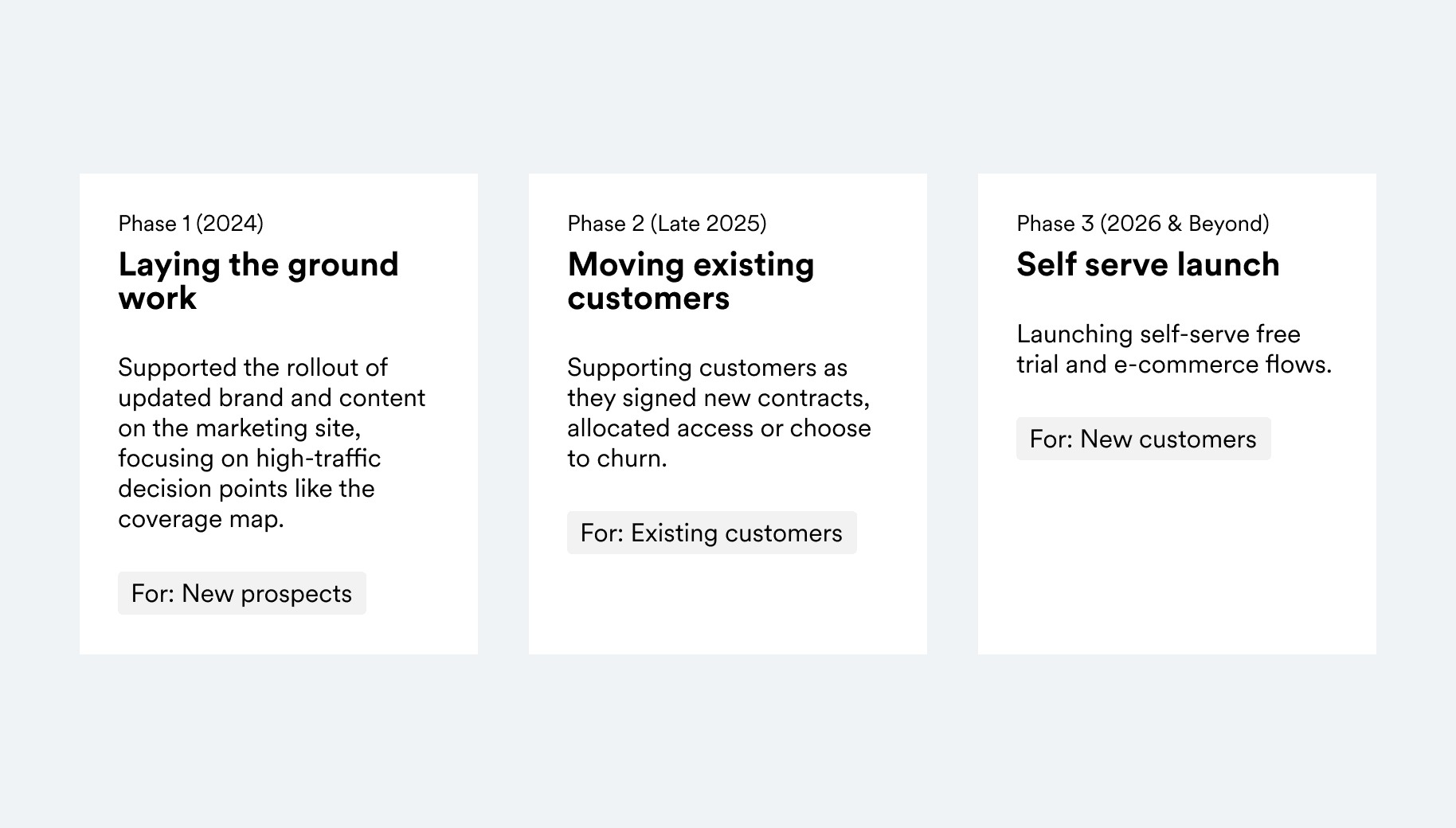
How this work rolled out over time
This work didn’t launch all at once. Existing customers were transitioned first, with new customer acquisition following later.
The work was sequenced to reduce risk for existing customers while laying the groundwork for future self-serve growth:
The challenge
Nearmap had spent over a decade serving customers through highly customised, sales driven contracts. While this worked well at scale, it created friction for smaller customers and made self serve growth difficult.
At the same time, existing customers couldn’t simply be “switched over”. Any change needed to preserve access, historical data, and trust, without creating support burden or accidental lock outs, and ideally with limited churn.
My role
I inherited a partially defined problem and owned the design of several flows that enabled Nearmap’s move toward this transition.
I was the sole designer responsible for:
Helping new customers start in the right place (free trial vs sales)
Supporting existing customers as they moved onto the new model
Designing access and admin foundations that could scale over time
Improving high-traffic decision points like the coverage map
I worked closely with product managers and engineer with legal involved as reviewers.
Answering the first question customers have
(Delivered earlier - 2024)
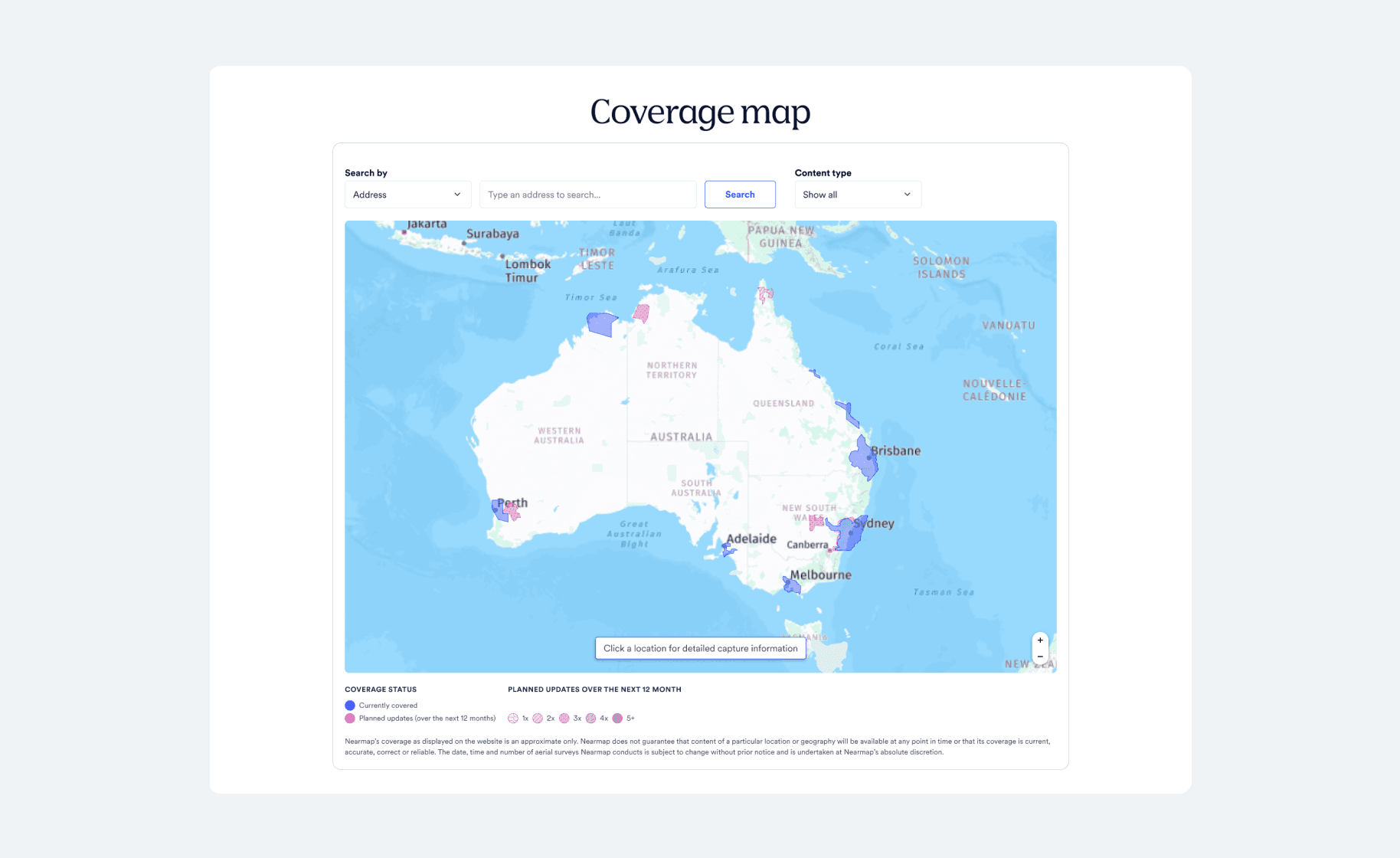
The coverage map was one of the most visited surfaces on the site and often the first place potential customers checked whether Nearmap could support their needs.
If users couldn’t quickly confirm coverage in the areas they cared about, they were unlikely to continue into a trial or sales conversation. The purpose of this was to help people answer a simple question early: Does Nearmap cover the areas I care about? If not, when will they?
I focused on designing a self-serve, high-trust experience that could handle complex geospatial data without overwhelming users.
Key problems I worked through:
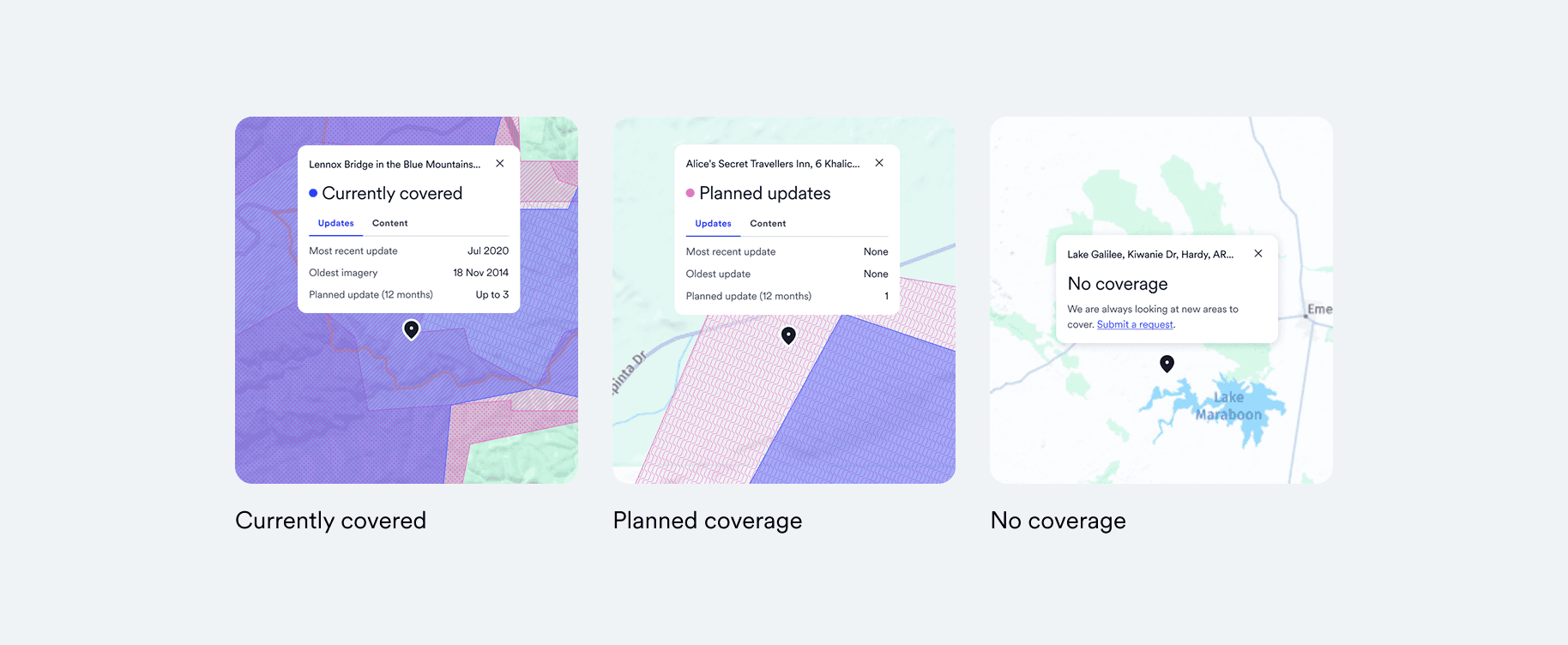
Making coverage status clear at a glance
Distinguishing current, planned, and no coverage
Surfacing content types and data recency without forcing a sales conversation
Handling edge cases (partial coverage, delayed updates, historical imagery)
Coverage status was communicated clearly across different search behaviours.
Not all searches resolve to a single point.
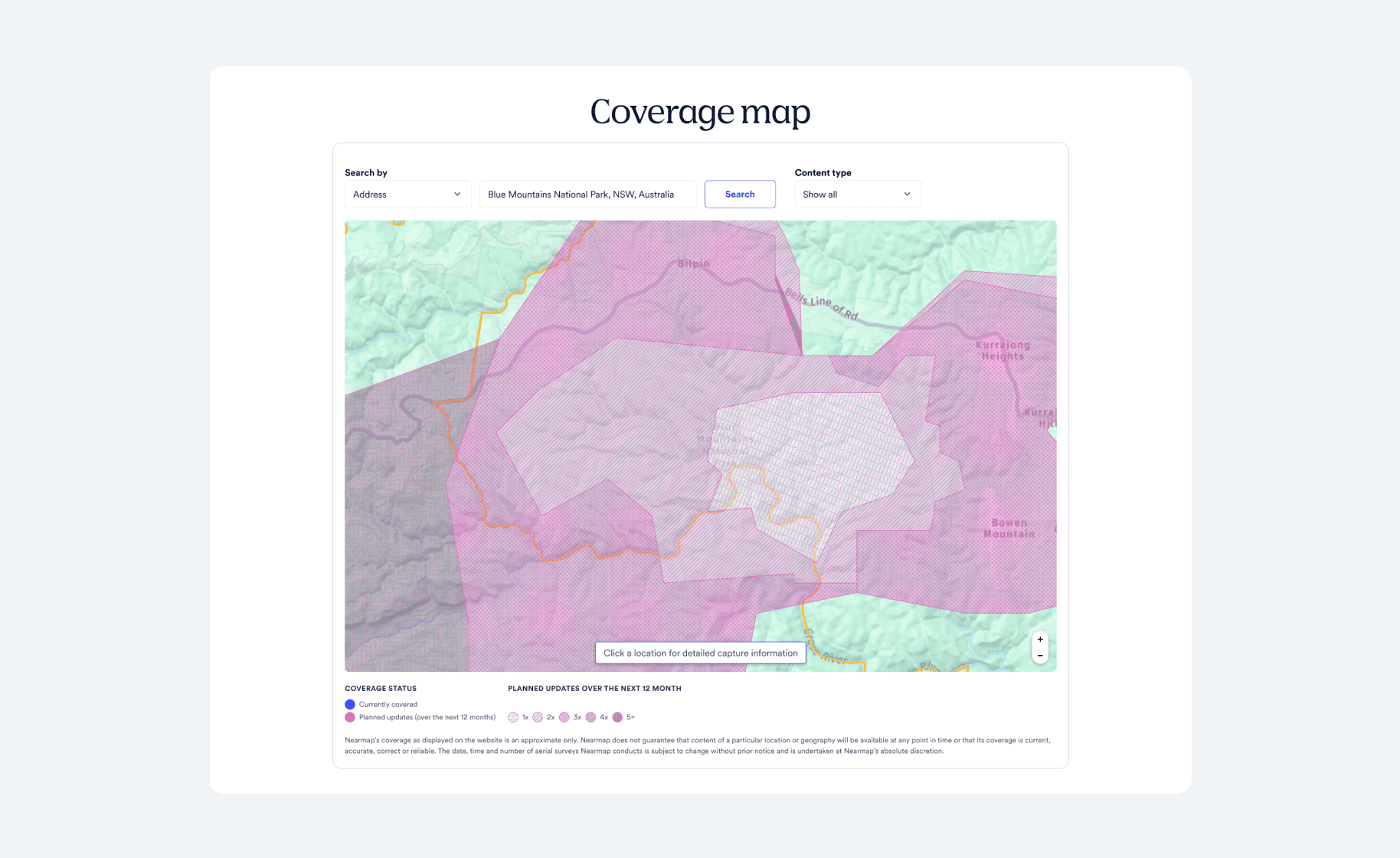
Searching by region
When users searched by a broader area instead of a specific address, the map showed coverage at a regional level without a pin or pop-up.
Impact
Following launch, the coverage map became a clearer entry point into the product, helping reduce uncertainty at a high-intent moment in the journey.
This work supported the broader shift toward more self-serve evaluation and reduced friction before sales engagement.
(Shipped late 2025)
Existing customers were tied to a legacy subscription model that behaved very differently to the new one - including how renewal, access and usage worked.
There was no neutral transition path: customers could upgrade, remain on the old model under different terms, or opt out entirely by churning. Inaction itself triggered a defined outcome, making clarity and predictability important.
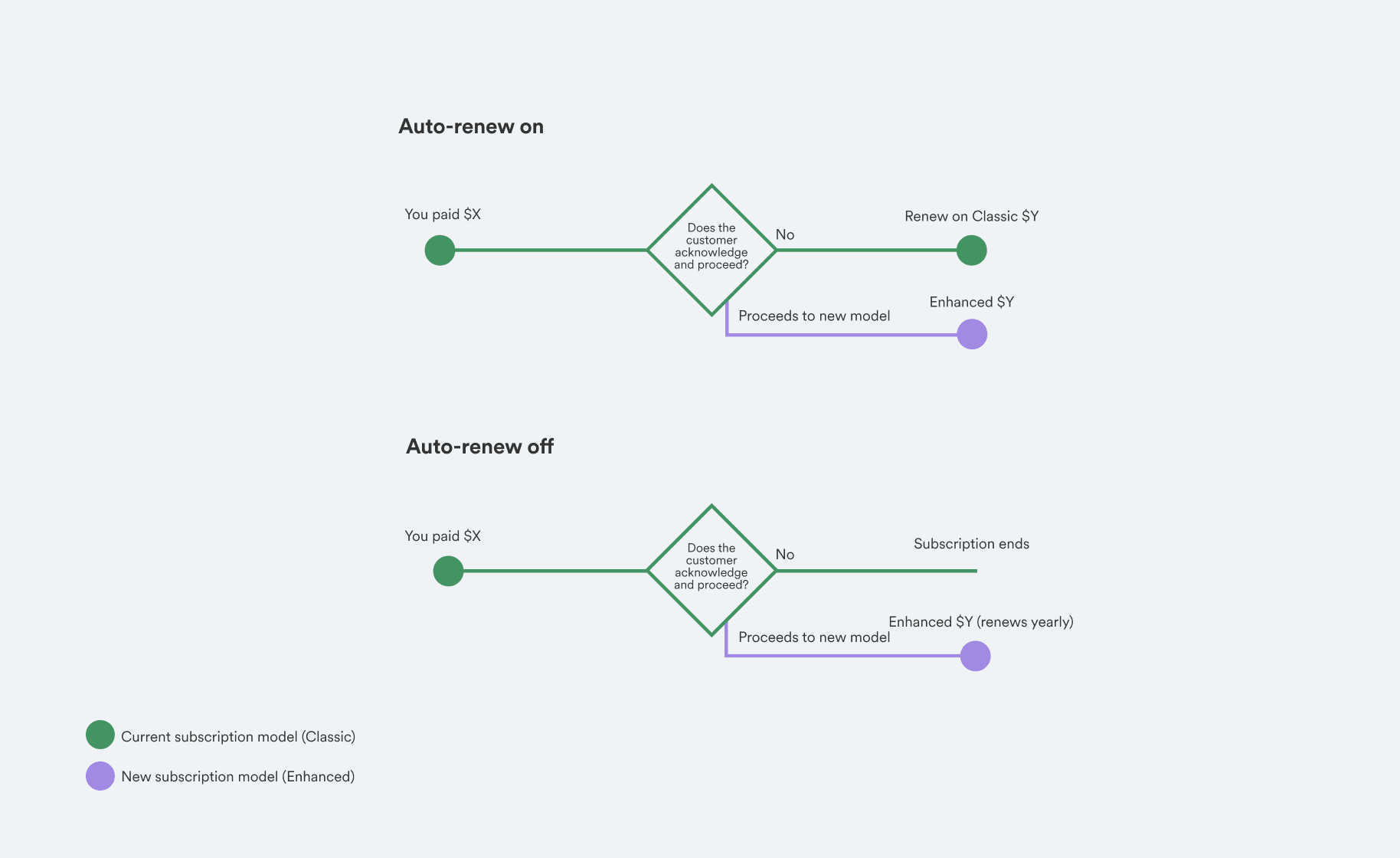
A critical edge case emerged around auto-renew behaviour.
Depending on whether auto-renew was on or off, doing nothing could lead to very different outcomes - including unintended churn or silent renewal under a new pricing model.
This created a high-risk moment where customers could make irreversible decisions without fully understanding the consequences.
Simplified decision logic highlighting where unintended outcomes could occur.
This transition had to work across regions (Australia and the US), account sizes, and legacy configurations, many of which didn’t map cleanly to the new model.
The goal wasn’t to persuade customers to upgrade, it was to make the consequences of inaction explicit, without surprise.
While customers could technically opt out of the change, doing so meant losing access entirely.
The design challenge was to reflect this reality, without using dark patterns or creating panic.
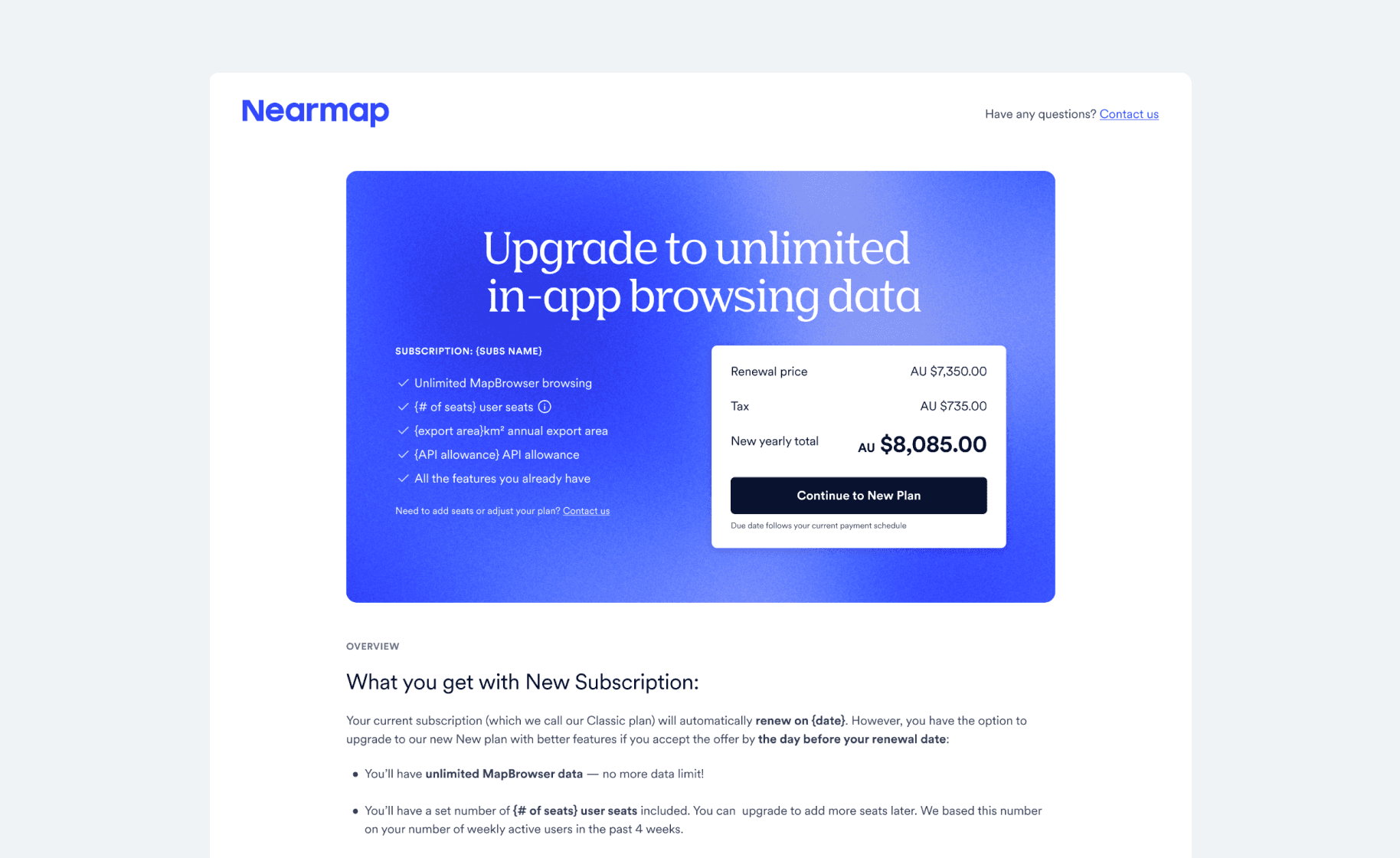
Designed to surface the outcome of doing nothing as clearly as the outcome of upgrading, before the renewal date.
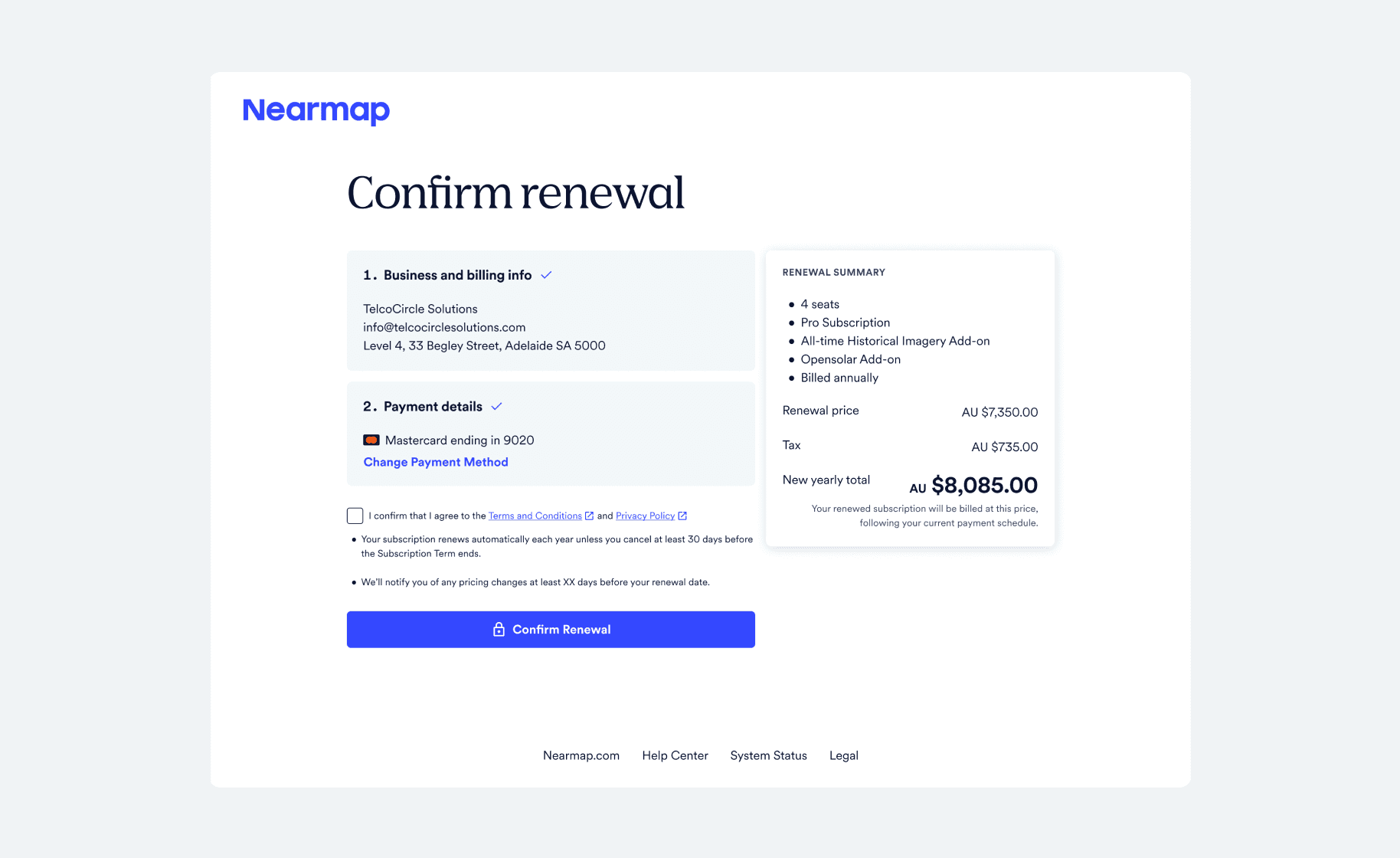
Screens shown are anonymised to respect customer and commercial confidentiality.
As part of the broader subscription transition, I worked on pre-seat allocation, which allowed admins to prepare access before the pricing change took effect.
Design focus:
Allowing admins to prepare before the switch
Making access states visible and reversible
Preventing last-minute surprises for teams
Supporting scale across different customer sizes
Admins were guided to review and adjust access ahead of time, with safe defaults applied to minimise disruption.
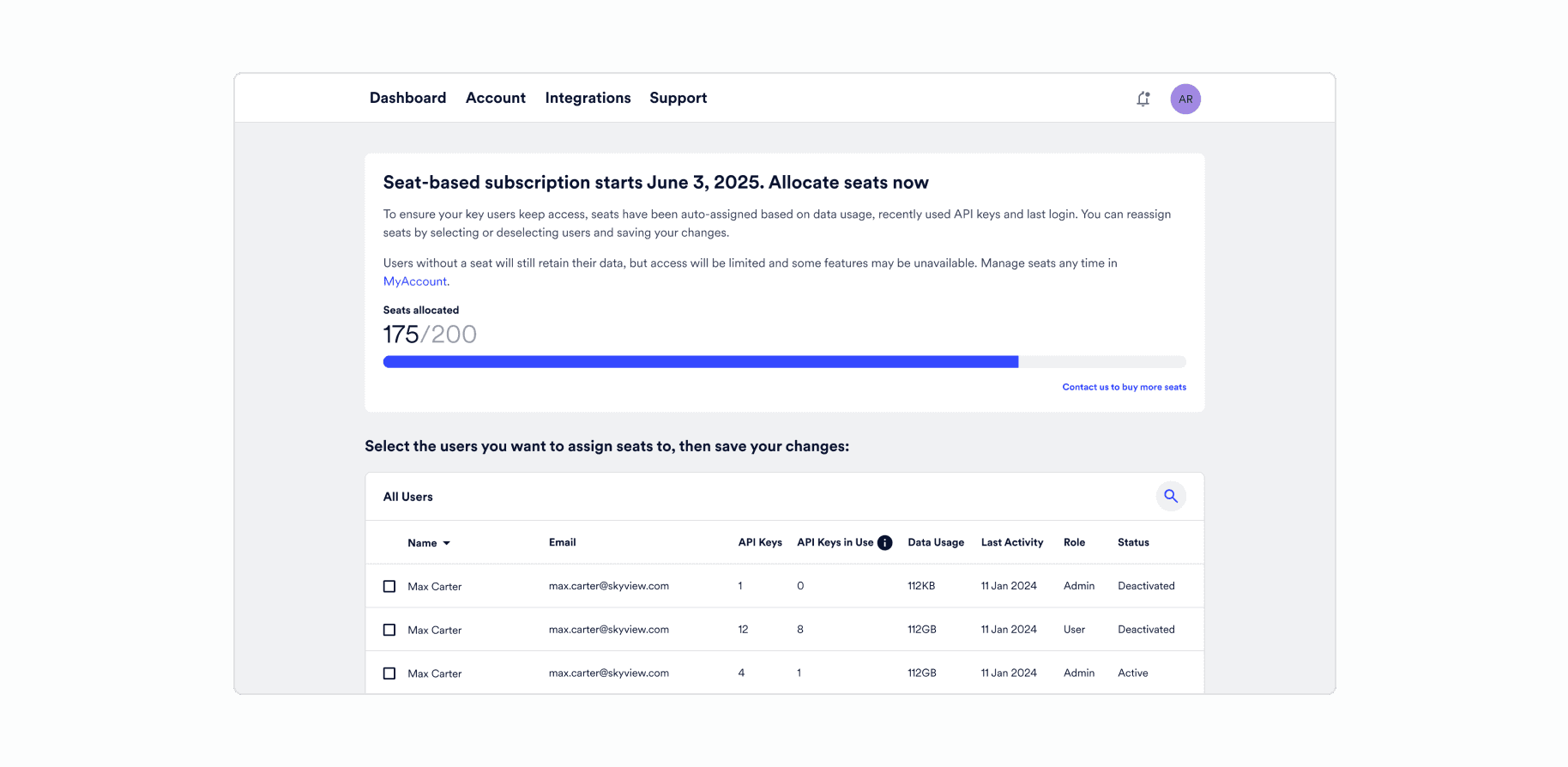
Seats were pre-allocated to reflect existing access, reducing the risk of accidental lockouts.
Following launch, the assisted migration flows became a clearer and safer path for existing customers, reducing uncertainty at a high-risk moment in the journey.
This work supported the broader shift toward a new pricing and access model while minimising disruption for teams and reducing friction before support or sales escalation.
Coming Soon
Getting new users onto the right path
(Future-facing - launching in 2026)
Since Nearmap prepared to introduce e-commerce, it became clear that not all customers should have the same starting experience.
Some users could begin a self-service experience immediately. Others needed a more guided, sales assisted entry. The difference depended on industry, company size, and the complexity of their needs.
The goal was to design an entry experience that supported e-commerce growth without forcing all customers through a single funnel.
Nearmap operated across multiple customer segments and products, each with different levels of complexity and readiness for self-serve.
A single entry risked:
misaligning expectations early
sending customers down the wrong path
weakening trust for more complex use cases
I focused on designing entry paths that:
balanced speed with suitability
supported both self-serve and assisted experiences
could scale alongside pricing and product changes
Rather than optimising for a single conversion moment, the work established a flexible foundation for e-commerce to grow over time.
A key design constraint was ensuring the right entry CTA appeared by region, using a two-stage location check (before and after page load), with safe fallbacks when location couldn’t be confirmed.
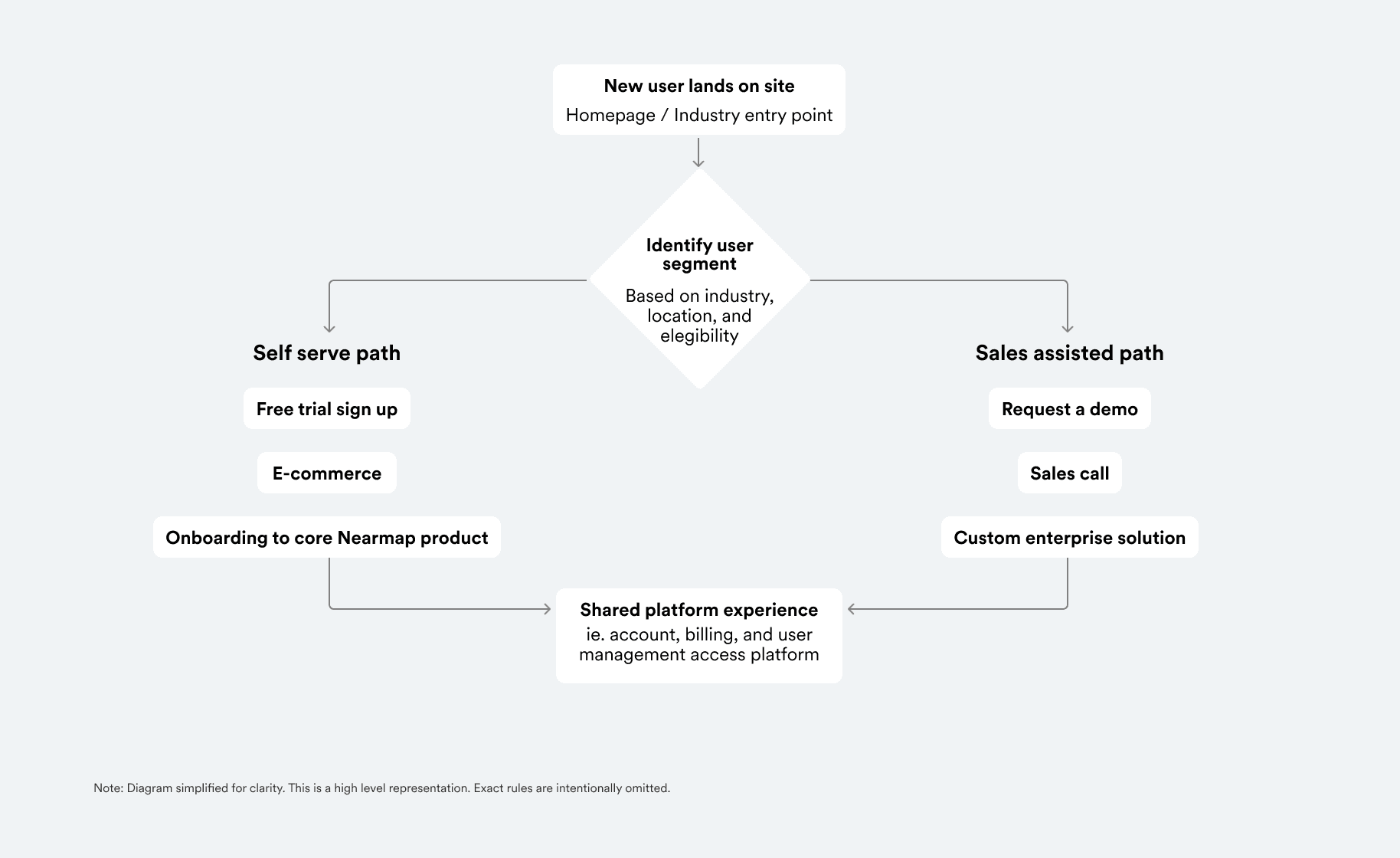
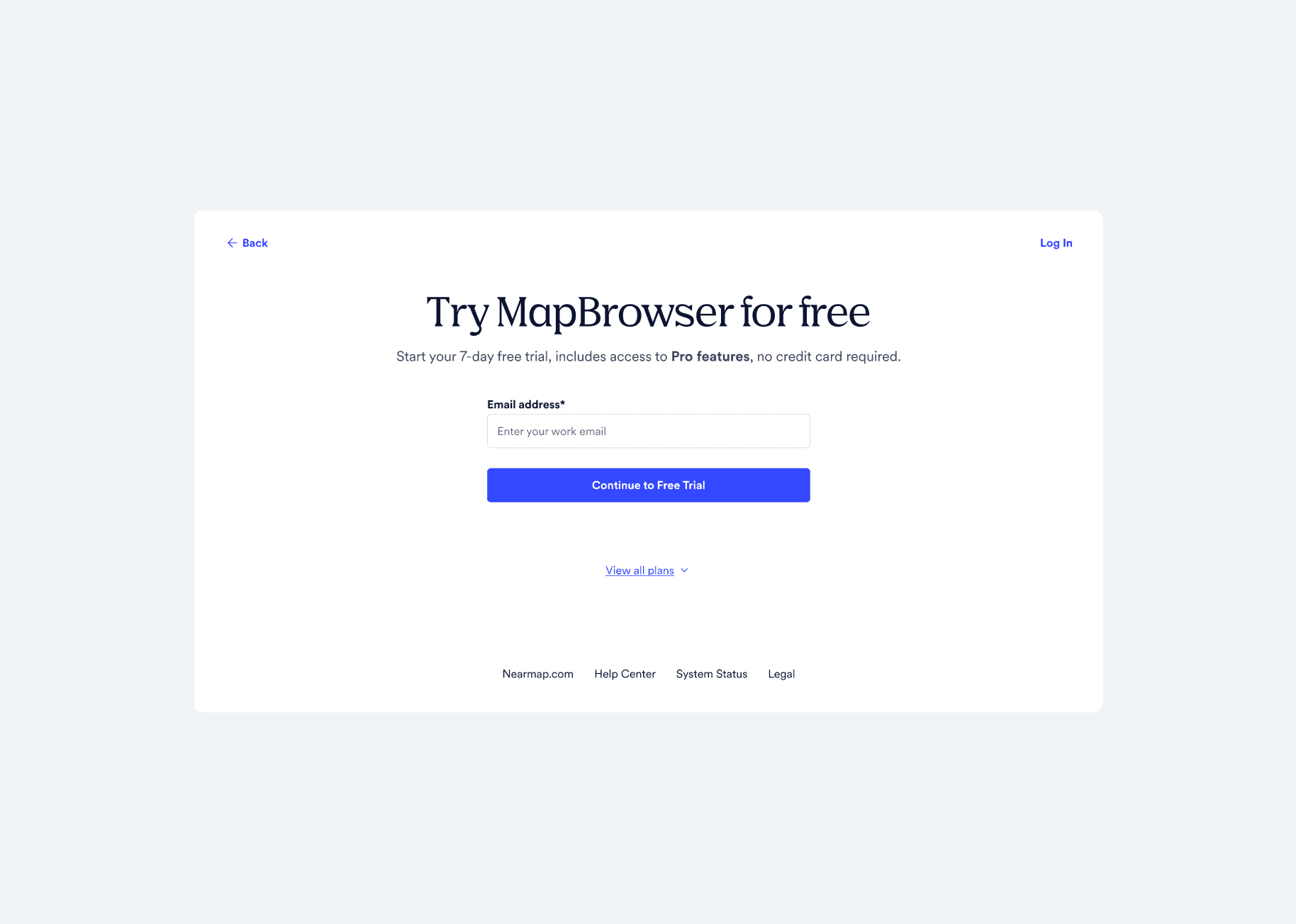
This work laid the groundwork for Nearmap’s transition toward e-commerce by aligning early experiences with customer intent and business strategy.
This phase is currently in development for a 2026 launch. To respect internal confidentiality and final UI are withheld here. Details will be added once the e-commerce experience is live.
Status & Impact
At the time of handover:
Moving existing customers onto the new system and pre-seat allocation were in engineering / QA
User management redesign was underway
Free trial designs were approved but not live yet.
The work laid foundations for:
Reduced risk during migration of existing customers data
Scalable seat based access
Future self-serve growth
Some details have been intentionally omitted, as parts of this work was still rolling out at the time of writing.
Reflection
Designing for clarity early helped reduce risk later, even when not every surface shipped at once.